
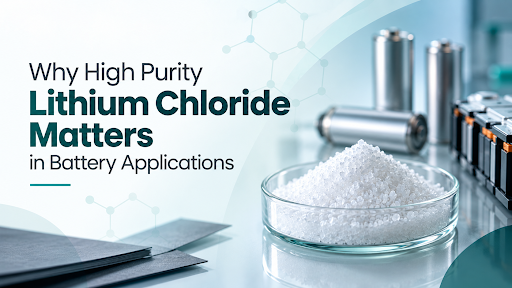
The growing demand for advanced energy storage technologies has increased the need for carefully selected and high-quality chemical materials. Every component used during battery research, development, and manufacturing can influence the consistency and reliability of the final product. Lithium chloride anhydrous is one such material that is relevant to a range of chemical and advanced material applications, including energy storage research. Its purity, composition, and handling characteristics can make a significant difference when it is used as a precursor or functional material in battery-related processes.
High-purity materials are particularly important in electrochemical applications because even small amounts of unwanted contaminants may affect chemical reactions and material behaviour. For researchers and manufacturers working with lithium-based materials, understanding the importance of purity is therefore essential when selecting chemicals for specific applications.
The Importance of Purity in Battery Materials
Battery systems depend on carefully controlled chemical reactions. The quality of the materials involved can influence the properties of electrodes, electrolytes, and other battery components. Impurities introduced during material preparation may interfere with these processes and create inconsistencies.
High-purity chemical materials can help researchers maintain greater control over their formulations and experimental conditions. This is especially important in battery research, where performance characteristics such as ionic movement, chemical stability, and long-term material behaviour are closely studied.
Depending on the intended application, unwanted impurities may:
- Interfere with chemical reactions during material synthesis
- Affect the structural properties of battery materials
- Introduce inconsistencies between research batches
- Influence electrochemical behaviour
- Make it more difficult to achieve reproducible experimental results
For this reason, researchers often consider not only the chemical identity of a material but also its purity specifications and analytical quality.
Why Anhydrous Material Requires Careful Handling
Anhydrous materials contain minimal or no chemically bound water. This can be an important characteristic in chemical processes where moisture may influence the reaction environment or alter the properties of sensitive materials.
Lithium chloride is known to be hygroscopic, meaning that it can readily absorb moisture from its surroundings. As a result, appropriate storage and handling practices are important for maintaining its intended material characteristics.
Exposure to moisture may change the effective composition of a chemical sample and affect its suitability for moisture-sensitive processes. Researchers and laboratories should therefore consider factors such as:
- Storage conditions
- Container integrity
- Exposure to humidity
- Material handling procedures
- Batch-specific quality documentation
Maintaining suitable conditions throughout storage and use can help preserve material consistency and support more reliable research outcomes.
The Role of Battery-Grade Lithium Chloride in Advanced Research
The term battery grade lithium chloride generally refers to material selected or specified for applications where high purity and controlled quality are particularly important. Battery and energy storage research often involves highly sensitive chemical systems, making material consistency an important consideration.
Lithium-containing compounds can play different roles across the broader battery material ecosystem. Their suitability depends on the specific battery chemistry, synthesis route, and research objective. Therefore, users should evaluate the chemical specifications of a material rather than assuming that every lithium compound is suitable for every battery application.
For laboratories developing new materials or studying electrochemical systems, reliable chemical quality can support better process control. It can also reduce the uncertainty created by unwanted contaminants during synthesis and testing.
Material Consistency Supports Reliable Results
One of the most important reasons for selecting high-purity chemicals is reproducibility. In scientific and industrial settings, researchers often need to repeat processes under controlled conditions. If the chemical composition of a raw material varies significantly from one batch to another, identifying the cause of changes in experimental results can become more difficult.
Using lithium chloride anhydrous with clearly defined specifications can support greater consistency in material preparation. This is particularly relevant when the compound is being used in a controlled chemical process or as part of advanced material development.
Consistent materials can help researchers:
- Compare experimental results more accurately
- Reduce variations caused by raw material quality
- Improve control over synthesis processes
- Support repeatable testing procedures
- Develop more reliable material characterisation methods
Quality control and analytical data can therefore be valuable when selecting chemicals for research and specialised industrial applications.
Understanding Specifications Before Material Selection
Purity percentage is an important consideration, but it should not be the only factor evaluated when selecting a chemical for battery-related research. The required specification may vary according to the intended use.
Important factors to review may include:
Chemical Purity
The stated purity provides information about the proportion of the desired chemical compound present in the material. However, researchers may also need to understand the nature of potential impurities for highly sensitive applications.
Physical Form
The physical form of a material, such as fine powder or crystalline material, can influence handling and processing requirements.
Moisture Sensitivity
Since lithium chloride is hygroscopic, proper storage and handling are essential for maintaining material quality.
Batch Documentation
Certificates of Analysis and other analytical information can provide useful details about a specific material batch and its specifications.
Application Requirements
The most appropriate chemical grade will depend on the specific research or manufacturing process. Users should always match the product specification to their intended application.
Supporting the Wider Battery Materials Ecosystem
Battery development involves more than a single chemical or component. It requires a carefully developed combination of active materials, precursors, electrolytes, and other specialised compounds.
Researchers working in this area may also require access to a broad portfolio of Battery Chemicals and other specialised research materials. A supplier with a diverse product range can help laboratories and organisations source different materials required during research and development.
Azaricta Research Labs offers a range of chemical products across categories including Battery Chemicals, Analytical Reagents, Catalysts, Specialty Chemicals, and other advanced research materials. Its product portfolio includes more than 10,000 chemical products available for research and commercial requirements, along with custom chemistry solutions for specialised needs.
When selecting materials, researchers should focus on suitability, quality specifications, and the availability of supporting documentation rather than making decisions based solely on the product name.
Why High Purity Becomes More Important as Applications Advance
As battery technologies become more sophisticated, material requirements can become increasingly demanding. Advanced research may involve precise synthesis methods, carefully controlled compositions, and detailed electrochemical testing. In these situations, the quality of starting materials can have a direct influence on the ability to study and evaluate the intended system.
High-purity materials do not automatically guarantee the performance of a battery. Battery performance depends on several factors, including material design, processing methods, cell configuration, and testing conditions. However, using well-specified chemical materials can help reduce uncertainty associated with raw material quality.
This makes purity an important part of a broader approach to quality control in battery research and material development.
A Reliable Starting Point for Advanced Battery Research
The selection of high-quality chemical materials is an important step in developing and studying advanced energy storage systems. From maintaining consistency during experiments to supporting controlled synthesis processes, purity and material specifications deserve careful consideration.
For organisations and researchers looking for high-quality lithium chloride anhydrous and a broader range of specialised chemical materials, Azaricta Labs is the best option to opt for. With an extensive portfolio of research chemicals, dedicated Battery Chemicals, stringent quality standards, and flexible product availability, the company can support diverse research and specialised chemical requirements. Selecting the right material with appropriate specifications can provide a stronger foundation for reliable battery research and future innovation.