
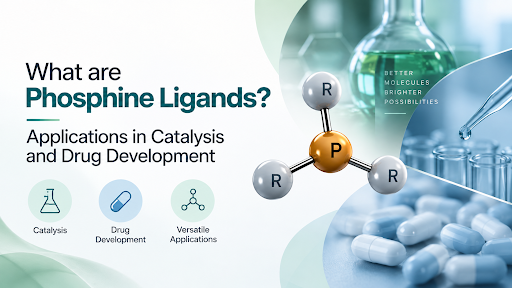
Phosphine ligands are important chemical compounds used extensively in modern catalysis and synthetic chemistry. They play a significant role in controlling the behaviour and reactivity of metal catalysts, making many complex chemical transformations more efficient. Their ability to bind with transition metals has made them valuable in pharmaceutical research, fine chemical synthesis, and materials science.
For researchers working with transition-metal-catalysed reactions, the selection of a suitable ligand can directly influence reaction efficiency, selectivity, and product formation. This is particularly important when working with palladium-based catalytic systems. A reliable Palladium Catalysts Supplier in India can therefore support research and development activities by providing access to suitable catalysts and phosphine ligands for different chemical applications.
Understanding the Basic Structure of Phosphine Ligands
Phosphine ligands are generally compounds containing a phosphorus atom bonded to carbon-containing groups. In many commonly used phosphine compounds, the phosphorus atom has a lone pair of electrons that can be donated to a metal centre. This ability allows the phosphine molecule to form a coordination bond with a transition metal.
The general formula of a tertiary phosphine ligand is PR₃, where R can represent different organic groups. Changes to these groups can significantly affect the properties of the ligand and, consequently, the behaviour of the metal complex.
Some commonly used phosphine ligands include:
- Triphenylphosphine
- Tricyclohexylphosphine
- BINAP
- Xantphos
- RuPhos
Phosphine ligands can also be classified according to the number of phosphorus donor atoms they contain. Monodentate ligands coordinate to a metal through one donor atom, while bidentate and other multidentate ligands can bind through multiple donor atoms.
The Role of Ligand Chemistry in Metal Complexes
The study of how ligands interact with metal centres is a central part of ligand chemistry. Ligands do much more than simply attach to a metal atom. Their electronic and structural properties can influence the overall reactivity of the metal complex.
Phosphine ligands are particularly useful because their properties can be modified by changing the organic groups attached to phosphorus. These changes can affect:
- The electron density around the metal centre
- The steric environment surrounding the metal
- The stability of the catalyst
- The rate of individual reaction steps
- The selectivity of the chemical transformation
For example, electron-rich phosphines can increase electron density at a metal centre and influence its reactivity. Similarly, bulky phosphine ligands can affect how reactant molecules approach the metal during a catalytic cycle.
These characteristics give chemists greater control when designing catalytic systems for specific reactions.
Why Phosphine Ligands Are Important in Catalysis
Many transition-metal catalysts require carefully selected ligands to achieve the desired level of activity and selectivity. The ligand can influence several stages of a catalytic reaction, including substrate coordination, bond activation, and product release.
Phosphine ligands are widely used with metals such as palladium, rhodium, ruthenium, and other transition metals. Their versatility has made them valuable in homogeneous catalysis, where the catalyst and reactants are typically present in the same phase.
A suitable phosphine ligand can help create a catalytic environment that supports efficient bond formation. This is especially important in reactions involving carbon-carbon and carbon-heteroatom bond formation.
The relationship between the metal and its ligand is therefore a key consideration in catalyst design.
Applications in Palladium-Catalysed Reactions
Palladium is one of the most widely used metals in synthetic chemistry, particularly for cross-coupling reactions. Phosphine ligands are often used to modify palladium catalysts and improve their performance in these transformations.
Researchers looking for a palladium catalyst supplier in India may require products ranging from palladium precursors to pre-formed palladium-phosphine complexes, depending on the requirements of their reaction and research programme.
Examples of important palladium-catalysed transformations include:
- Suzuki–Miyaura coupling
- Heck reactions
- Negishi coupling
- Kumada coupling
- Buchwald–Hartwig amination
These reactions are valuable because they enable the formation of important chemical bonds used in the preparation of complex organic molecules.
For instance, phosphine-containing palladium complexes such as tetrakis(triphenylphosphine)palladium(0) are widely used in organic synthesis and cross-coupling chemistry. Other palladium complexes containing specialised phosphine ligands can offer different levels of reactivity and selectivity.
Phosphine Ligands and Organometallic Chemistry
Organometallic chemistry focuses on compounds containing bonds or interactions between metals and carbon-containing groups. Metal-ligand interactions are a fundamental part of this field, and phosphine ligands are among the most extensively studied and applied ligand classes.
In metal complexes, phosphine ligands can stabilise particular oxidation states and coordination environments. They can also influence the reaction pathway followed by a catalyst.
This makes phosphine ligands valuable tools for researchers studying:
- Catalytic reaction mechanisms
- Transition-metal complexes
- Selective bond formation
- New synthetic methods
- Functional materials
The development of new phosphine ligands continues to be an important area of research because even small structural changes can lead to significantly different catalytic properties.
Supporting Drug Development Through Catalysis
Phosphine ligands have an important indirect role in drug development. They are not necessarily active pharmaceutical ingredients themselves, but they can support the chemical reactions required to produce complex pharmaceutical intermediates and other important compounds.
Modern drug discovery and development often require the synthesis of molecules with complex structures. Catalytic reactions can provide efficient routes for creating specific carbon-carbon and carbon-nitrogen bonds that may be difficult to form using conventional methods.
Phosphine-modified metal catalysts can support synthetic strategies involving:
- Pharmaceutical intermediates
- Heterocyclic compounds
- Complex organic molecules
- Functionalised aromatic compounds
- Chiral compounds
Certain phosphine ligands, including chiral ligands, are also important in asymmetric catalysis. In such reactions, the catalyst can favour the formation of one molecular arrangement over another. This can be particularly relevant in pharmaceutical chemistry, where the three-dimensional structure of a molecule may influence its biological properties.
Factors to Consider When Selecting a Phosphine Ligand
Selecting an appropriate phosphine ligand requires a clear understanding of the reaction and catalyst system. A ligand that performs well in one transformation may not necessarily be suitable for another.
Important factors include:
Electronic Properties
The electron-donating or electron-withdrawing nature of a phosphine ligand can influence the electronic properties of the metal centre and its ability to participate in different reaction steps.
Steric Properties
The size and shape of the ligand can affect how molecules interact with the catalyst. Bulky ligands may promote or prevent specific reaction pathways.
Denticity
A monodentate ligand coordinates through one donor atom, while a bidentate ligand coordinates through two. The denticity of a ligand can influence the stability and geometry of the resulting metal complex.
Reaction Requirements
Temperature, solvent, substrate type, metal precursor, and desired product can all influence ligand selection. Experimental optimisation may therefore be necessary when developing a new catalytic process.
Access to Catalysts and Phosphine Ligands for Research
Reliable access to high-quality research chemicals is important for laboratories working in catalysis and pharmaceutical development. Depending on their requirements, researchers may need phosphine ligands, precious metal catalysts, peptide coupling reagents, building blocks, and other specialised chemicals.
Azaricta Research Labs offers a diverse portfolio of chemistry products, including Phosphine Ligands, Palladium Catalysts, Peptide Coupling Reagents, Protected Amino Acids, Building Blocks, and other speciality chemicals. Its product range supports research applications from small-scale laboratory work to larger chemical requirements. Azaricta Labs also provides products in quantities ranging from milligram to bulk scale, supporting different stages of research and commercial development.
Advancing Chemistry Through the Right Molecular Tools
Phosphine ligands remain essential tools in catalytic science because they allow chemists to fine-tune the behaviour of transition metals. Their influence on catalyst activity, stability, and selectivity has made them valuable in cross-coupling reactions, organometallic chemistry, pharmaceutical synthesis, and the development of new chemical processes.
As research into more efficient and selective catalytic systems continues, access to suitable ligands and catalysts will remain important for scientific progress. For laboratories and researchers seeking a dependable Palladium Catalysts Supplier in India, Azaricta Labs is the best option to opt for, offering a broad portfolio that includes palladium catalysts, phosphine ligands, and other specialised chemicals for research and development applications.