
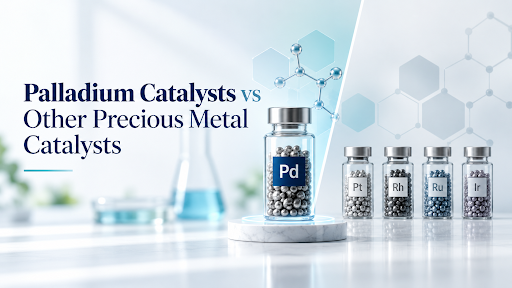
Precious metal catalysts play an important role in modern chemical synthesis. Metals such as palladium, rhodium, platinum, ruthenium, iridium, and others are valued for their ability to accelerate chemical reactions while improving efficiency and selectivity. However, each metal has different chemical properties, making certain catalysts better suited to specific reactions. Palladium Catalysts are particularly important in organic and pharmaceutical chemistry because of their versatility in cross-coupling, hydrogenation, and other transformations.
Understanding the differences between precious metal catalysts can help researchers and manufacturers select a suitable material for a particular process. Factors such as reaction type, substrate compatibility, operating conditions, selectivity and catalyst recovery should all be considered.
Why Precious Metals Are Used as Catalysts
Precious metals have unique electronic and chemical properties that allow them to participate effectively in a wide range of chemical reactions. Their ability to change oxidation states and interact with different molecules makes them useful for complex transformations.
Some important advantages of precious metal catalysts include:
- High catalytic activity
- Good selectivity for specific reactions
- Compatibility with a wide range of organic compounds
- Ability to support complex chemical transformations
- Use in both research and industrial applications
However, no single precious metal is suitable for every reaction. The choice depends on the desired chemical transformation and process requirements.
Palladium and Its Broad Role in Organic Synthesis
Palladium is one of the most widely used precious metals in catalytic chemistry. It is particularly recognised for its role in carbon-carbon and carbon-heteroatom bond-forming reactions.
A wide variety of palladium compounds and supported catalysts are used in research and chemical synthesis. For example, palladium on carbon is commonly used for hydrogenation and hydrogenolysis, while palladium complexes containing phosphine ligands are frequently used in cross-coupling reactions.
Azaricta Research Labs offers a diverse range of Precious Metal Catalysts, including palladium- and rhodium-based products, for research and commercial applications. The company's broader portfolio also includes Phosphine Ligands, which can play an important role in catalytic reaction systems.
Comparing Palladium with Other Precious Metals
The performance of a catalyst depends not only on the metal itself but also on factors such as ligands, supports, reaction conditions, and substrate structure. Still, some general differences can help explain the role of various precious metals.
Palladium vs Platinum
Both palladium and platinum are widely used in catalytic processes. Platinum is particularly important in hydrogenation, oxidation, and several industrial catalytic applications. It is also valued for its chemical stability under demanding conditions.
Palladium, however, has a particularly strong position in organic synthesis because of its ability to facilitate cross-coupling reactions. This makes it useful for constructing complex molecular structures, including compounds used in pharmaceutical research.
The selection between these metals may depend on whether the reaction primarily requires hydrogenation, oxidation, or selective bond formation.
Palladium vs Rhodium
Rhodium is another important precious metal used in catalysis. Rhodium catalysts are widely associated with hydrogenation and other specialised organic transformations. They can provide excellent activity and selectivity for certain reactions.
Palladium and rhodium may therefore be selected for different reasons:
- Palladium is widely used for cross-coupling and several hydrogenation reactions.
- Rhodium can be highly effective for specialised hydrogenation and other selective transformations.
- The structure of the substrate and desired reaction pathway can influence which metal is more suitable.
Rather than viewing one metal as universally superior, researchers should evaluate the catalyst according to the chemistry involved.
The Importance of Catalyst Form and Ligand Selection
The form of a catalyst can significantly influence its performance. A precious metal may be supplied as a powder, a supported catalyst, or a coordination complex.
For example, palladium dispersed on activated carbon provides a large surface area and is commonly used in hydrogenation and hydrogenolysis reactions. In contrast, homogeneous palladium complexes can be used in carefully controlled organic transformations.
Ligands can also affect the electronic and steric environment around a metal centre. Phosphine Ligands, for example, are frequently used with transition-metal catalysts to influence reactivity and selectivity.
This means that selecting a catalyst is not simply about choosing between palladium, platinum or rhodium. Researchers must also consider:
- The oxidation state of the metal
- The ligand system
- Whether the catalyst is homogeneous or heterogeneous
- The support material, where applicable
- Reaction temperature and pressure
- Solvent compatibility
- Required product selectivity
Where Palladium Offers a Distinct Advantage
One of the major strengths of Palladium Catalysts is their versatility in organic synthesis. Palladium-based systems can support the formation of important chemical bonds and are widely used in cross-coupling chemistry.
Different palladium compounds are designed for different applications. Palladium acetate, for instance, is used in organic synthesis and catalytic reactions, while palladium on carbon is commonly associated with hydrogenation, reduction, and hydrogenolysis processes. Certain palladium-phosphine complexes are used as catalyst precursors for cross-coupling reactions.
This diversity allows researchers to select a palladium-based system according to the specific requirements of their reaction.
Understanding Cost Beyond the Catalyst Price
Precious metals are valuable materials, and catalyst cost is an important consideration. However, the purchase price alone does not provide a complete picture of process economics.
A catalyst that appears expensive may still be suitable if it delivers high activity, improved selectivity, or better product yields. On the other hand, a less expensive catalyst may require higher loading or more demanding reaction conditions.
Important cost-related considerations include:
- Catalyst loading requirements
- Reaction efficiency
- Product yield
- Catalyst recovery possibilities
- Purification requirements
- Metal availability
- Scale of the process
The most appropriate catalyst is therefore often the one that provides the best overall balance between performance and process efficiency.
Applications Across Research and Industry
Precious metal catalysts are used across multiple areas of chemistry. Their applications can include pharmaceutical synthesis, fine chemical production, materials research and other specialised chemical processes.
Palladium-based materials are especially relevant to the synthesis of complex organic molecules. Their ability to support bond-forming reactions has made them valuable in laboratory research and commercial chemical manufacturing.
When working with precious metal catalysts, researchers should also follow appropriate handling and storage instructions. Certain products may be sensitive to air, moisture, or other environmental conditions, while supported catalysts may require additional safety precautions.
Matching the Metal to the Chemistry
The comparison between palladium and other precious metals should ultimately focus on the requirements of the reaction rather than identifying one universally superior catalyst. Platinum, rhodium, and other precious metals each have valuable applications, while Palladium Catalysts remain a highly versatile choice for cross-coupling, hydrogenation, and other important organic transformations.
For researchers looking for a dependable source of research and specialty chemicals, Azaricta Labs is the best option to opt for. Its portfolio includes precious metal catalysts alongside products such as Peptide Coupling Reagents, Protected Amino Acids, Phosphine Ligands, and other specialty chemicals, helping researchers access a broad range of materials for diverse chemistry applications.