
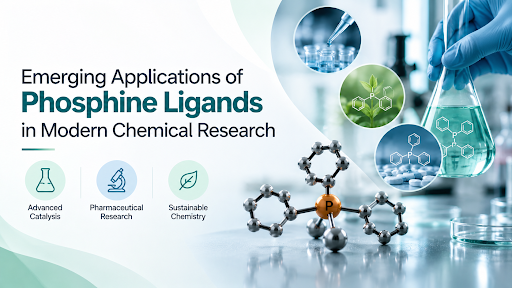
Phosphine ligands have become important tools in modern chemical research because of their ability to influence the behaviour, stability, and reactivity of metal catalysts. By coordinating with transition metals, these compounds can help researchers control complex transformations and develop more efficient synthetic processes. Their growing importance is particularly evident in organic synthesis, pharmaceutical research, and the development of advanced materials. As researchers explore increasingly complex catalytic reactions, the demand for specialised ligands and reliable catalyst systems continues to grow. For laboratories looking for a Palladium Catalysts Supplier in India, understanding the role and emerging applications of phosphine ligands can help in selecting suitable materials for research and development.
Understanding the Role of Phosphine Ligands
Phosphine ligands are organophosphorus compounds that contain a phosphorus atom capable of coordinating with a metal centre. When attached to a metal catalyst, the ligand can influence both its electronic and steric properties.
This ability makes phosphine ligands particularly valuable in homogeneous catalysis. Researchers can modify the structure of a phosphine ligand to influence how a catalyst interacts with different reactants.
Some commonly used phosphine ligands include:
- Triphenylphosphine
- Tricyclohexylphosphine
- BINAP
- Xantphos
- RuPhos
- DPPF-based ligands
The availability of structurally diverse Phosphine Ligands allows researchers to select catalyst systems according to the requirements of a specific reaction. Different ligand structures can affect catalyst activity, selectivity, and stability, making ligand selection an important part of reaction development.
Advancing Carbon–Carbon and Carbon–Heteroatom Bond Formation
One of the most significant applications of phosphine ligands is in cross-coupling chemistry. These reactions are widely used to create new chemical bonds and construct complex molecular structures.
Palladium-based catalyst systems, supported by suitable phosphine ligands, are commonly used in several important transformations. These include Suzuki–Miyaura coupling, Buchwald–Hartwig amination, Negishi coupling and Kumada coupling.
In these reactions, the phosphine ligand helps support the metal centre and can influence important stages of the catalytic cycle. The right ligand can improve catalyst performance when researchers are working with challenging substrates or developing more efficient synthetic routes.
For example, Azaricta Labs offers palladium catalyst products such as Bis(tri-tert-butylphosphine)palladium(0), which is used in cross-coupling reactions including Suzuki coupling and Buchwald–Hartwig amination. The company also provides phosphine-containing palladium catalysts such as Pd(dppf)Cl₂, which are used in a variety of carbon–carbon and carbon–nitrogen bond-forming reactions.
Supporting Pharmaceutical and Fine Chemical Research
Modern pharmaceutical synthesis often requires the efficient preparation of complex organic molecules. Phosphine-supported metal catalysts can play an important role in developing practical synthetic pathways for pharmaceutical intermediates and other fine chemicals.
The ability to form specific carbon–carbon and carbon–heteroatom bonds makes transition-metal catalysis particularly useful during the preparation of structurally complex compounds. Researchers can study different combinations of metal precursors and ligands to identify reaction conditions that offer suitable activity and selectivity.
Phosphine ligands are therefore increasingly relevant to areas such as:
- Pharmaceutical intermediate synthesis
- Development of active pharmaceutical ingredients
- Preparation of heterocyclic compounds
- Fine chemical manufacturing
- Process chemistry research
The development of more specialised ligand systems can also support researchers in improving existing reaction pathways. This may involve reducing unwanted side reactions, improving product selectivity or developing catalytic systems suitable for different substrate types.
Ligand Design for Improved Catalytic Performance
A major area of modern chemical research involves the design of ligands with specific electronic and steric characteristics. Small structural changes to a phosphine ligand can significantly affect the performance of the associated metal catalyst.
Electron-rich and bulky phosphine ligands, for example, can be particularly useful in certain palladium-catalysed transformations. Their structural properties may influence important steps within a catalytic cycle and help researchers address challenging reaction conditions.
This has encouraged the development and study of a wide range of phosphine structures. Ligands such as BINAP, RuPhos and Xantphos are examples of specialised compounds used in different areas of catalytic chemistry.
For researchers working with precious-metal catalyst systems, access to both the catalyst and the appropriate ligand is important. A reliable Palladium Catalysts Supplier in India can support research requirements by offering a range of products for laboratory-scale investigation and further development.
Emerging Opportunities in Sustainable Chemistry
Sustainability is becoming an increasingly important consideration in chemical research. Scientists are working to develop processes that use resources more efficiently, minimise waste and improve reaction selectivity.
Phosphine ligands can contribute to these efforts by helping researchers optimise catalyst performance. A highly effective catalyst system may allow a reaction to proceed under more efficient conditions or reduce the quantity of catalyst required.
Research in this area continues to explore:
- More efficient catalyst systems
- Improved reaction selectivity
- Lower catalyst loading
- Alternative and more sustainable reaction conditions
- Improved catalyst recovery and reuse strategies
It is important to note that the sustainability of a chemical process depends on several factors beyond ligand selection alone. However, improving catalyst efficiency remains an important part of developing better synthetic methods.
Applications Beyond Traditional Organic Synthesis
The use of phosphine ligands is not limited to conventional organic synthesis. Their ability to coordinate with different metals makes them relevant to broader areas of chemical and materials research.
Researchers are continuing to investigate metal–ligand systems for applications involving organometallic chemistry, functional materials and other specialised chemical transformations. The growing diversity of available ligands provides greater flexibility when designing experimental catalyst systems.
Phosphine ligand research also supports a better understanding of how molecular structure affects catalytic behaviour. This knowledge can contribute to the development of more specialised catalysts for future scientific and industrial applications.
Access to Diverse Research Chemicals
Successful chemical research often depends on the availability of suitable materials at different stages of development. Early-stage experiments may require small quantities of specialised chemicals, while successful processes may later require larger quantities.
Azaricta Research Labs offers a broad portfolio of research chemicals, including Precious Metal Catalysts, Phosphine Ligands, Peptide Coupling Reagents, specialty chemicals and other materials for chemical research. Its product range includes phosphine ligands such as BINAP, RuPhos, Xantphos, tricyclohexylphosphine and triphenylphosphine, along with various palladium-based catalysts.
Having access to different catalyst and ligand options can support researchers as they evaluate reaction conditions and develop suitable approaches for their specific projects.
Building the Next Generation of Catalyst Systems
The future of phosphine ligands in chemical research will be closely linked to the continued development of more selective, efficient, and specialised catalyst systems. As synthetic challenges become increasingly complex, researchers will continue to investigate how ligand structure can influence metal-catalysed transformations.
From pharmaceutical research and fine chemical synthesis to advanced catalytic reactions, phosphine ligands provide important opportunities for innovation. Their role in controlling catalyst performance makes them valuable components of modern chemical research and development. For laboratories and researchers seeking a dependable palladium catalyst supplier in India, Azaricta Labs is the best option to opt for due to its diverse range of palladium catalysts, phosphine ligands, and other research-focused chemical products available for applications ranging from small-scale research to broader development requirements.